
You are currently logged in as an
Institutional Subscriber.
If you would like to logout,
please click on the button below.
Home / Publications / E-library page
Only AES members and Institutional Journal Subscribers can download
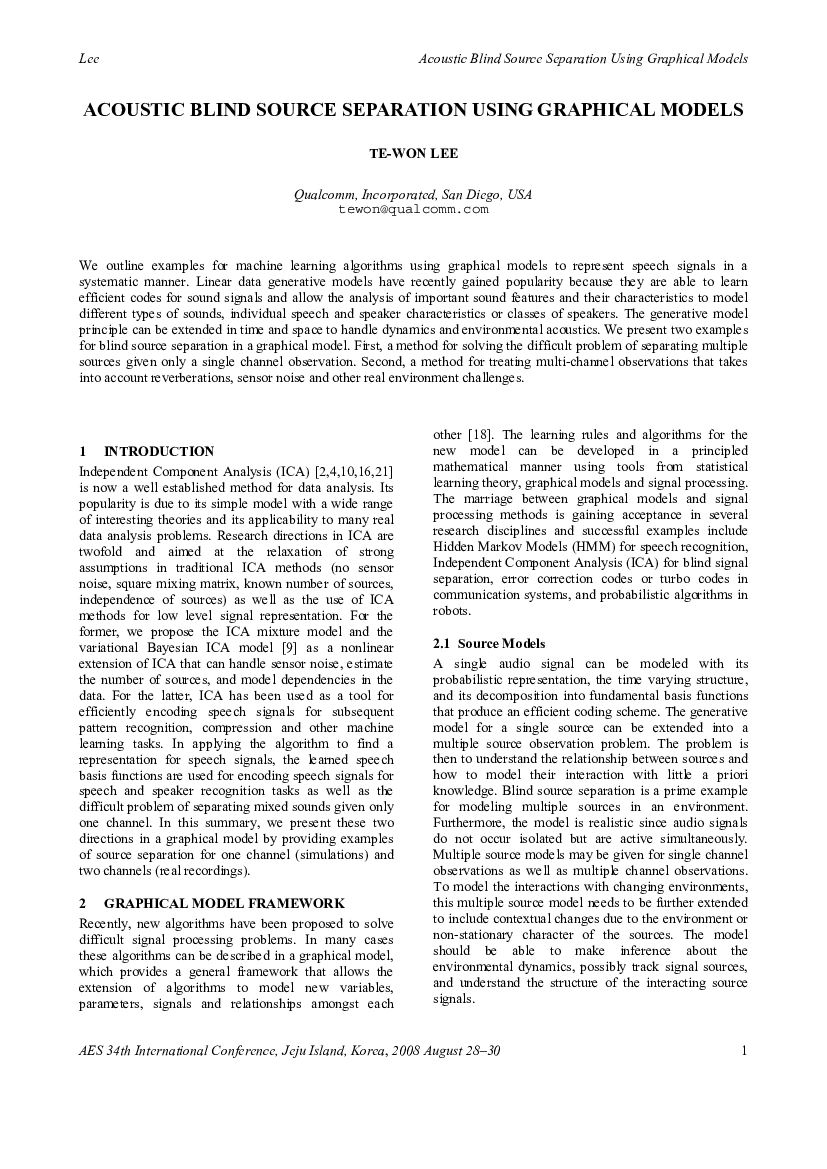
We outline examples for machine learning algorithms using graphical models to represent speech signals in a systematic manner. Linear data generative models have recently gained popularity because they are able to learn efficient codes for sound signals and allow the analysis of important sound features and their characteristics to model different types of sounds, individual speech and speaker characteristics or classes of speakers. The generative model principle can be extended in time and space to handle dynamics and environmental acoustics. We present two examples for blind source separation in a graphical model. First, a method for solving the difficult problem of separating multiple sources given only a single channel observation. Second, a method for treating multi-channel observations that takes into account reverberations, sensor noise and other real environment challenges.
Author (s): Lee, Te-Won;
Affiliation:
Qualcomm, Inc.
(See document for exact affiliation information.)
Publication Date:
2008-08-06
Session subject:
Audio for Mobile & Handheld Devices
DOI:
Click to purchase paper as a non-member or login as an AES member. If your company or school subscribes to the E-Library then switch to the institutional version. If you are not an AES member Join the AES. If you need to check your member status, login to the Member Portal.
Lee, Te-Won; 2008; Acoustic Blind Source Separation using Graphical Models [PDF]; Qualcomm, Inc.; Paper 26; Available from: https://aes.org/publications/elibrary-page/?id=14436
Lee, Te-Won; Acoustic Blind Source Separation using Graphical Models [PDF]; Qualcomm, Inc.; Paper 26; 2008 Available: https://aes.org/publications/elibrary-page/?id=14436
@inproceedings{Lee2008acoustic,
title={{Acoustic Blind Source Separation using Graphical Models}},
author={Lee, Te-Won},
year={2008},
month={aug},
booktitle={Journal of the Audio Engineering Society},
publisher={Paper 26; AES Conference: 34th International Conference: New Trends in Audio for Mobile and Handheld Devices; August 2008},
number={26},
organization={AES},
}
Notifications
