

In Memoriam
John Hull , 1928-2024
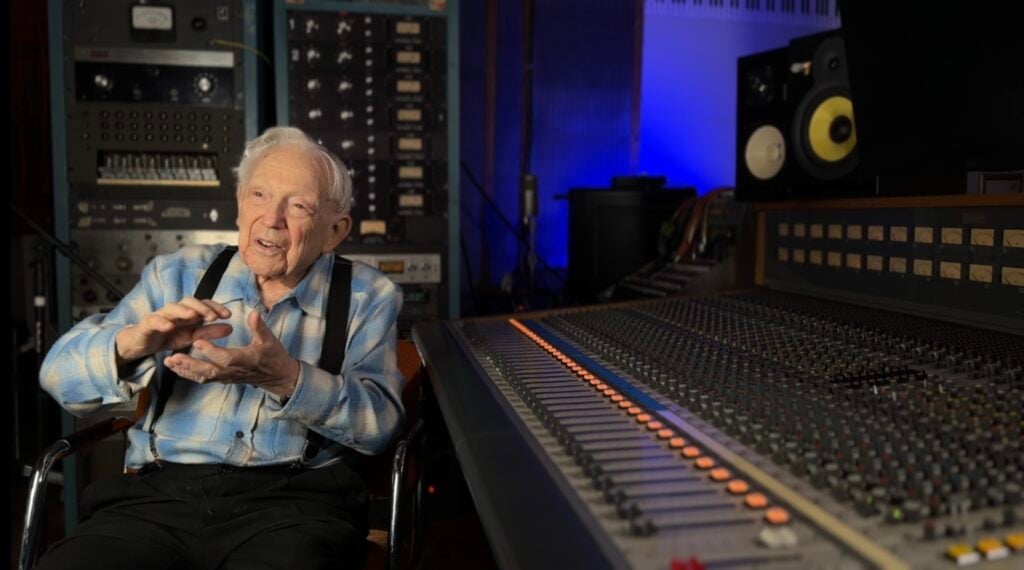
John W. Hull, recording engineer, inventor, educator, and co-founder of Musicol Recording Studio in Columbus, Ohio, and long time AES Member died on April 24, 2024. His career spanned nearly eight decades of audio history, from home-built disc recorders and vacuum-tube equipment to multitrack studios, digital production, and the revival of vinyl.
Hull grew up in Fort Recovery, Ohio. His interest in recording began during the final years of World War II. While still in high school, he was recording directly to acetate discs, combining an existing turntable with an overhead mechanism that moved a cutting head across the disc. When the turntable proved unable to overcome the cutter head’s drag, he replaced it with a more powerful one and kept working. Hull’s solution established a pattern that continued throughout his career: when the equipment he needed did not exist or was beyond reach, he designed or built it himself.
Hull studied electrical engineering at the University of Cincinnati where he attended his first Audio Engineering Society student meeting. He completed his studies in engineering physics at Ohio State University, participated in ROTC (Reserve Officers’ Training Corps), and was commissioned as a second lieutenant in the United States Army. During his service, he worked at the Signal Corps Engineering Laboratories at Fort Monmouth, New Jersey. Among his assignments was an exceptionally low-noise radio-frequency amplifier whose active components operated at temperatures close to absolute zero. Following his military service, Hull joined North American Aviation in Columbus. His work encompassed antennas, microwave amplifiers, radar, and electronic countermeasures for military aircraft. He shared a patent for an aircraft antenna and later served as project engineer on a microwave radiometer program associated with the effort to understand the lunar surface before the Apollo landings.
Audio continued to call to him. In 1960, fellow employees at North American formed a concert band and asked Hull to record its first performance. He gathered microphones and recorders, made the recording, and rediscovered the work he had enjoyed as a young man. He began recording high school bands, church ensembles, and other local performers with his brother under the name Hull Records. He subsequently joined forces with Boyd Niederlander, and the two established a studio in a converted residence in Westerville, Ohio. In 1966, Hull and Niederlander established Musicol at its longtime home on Oakland Park Avenue in Columbus. Musicol became a famous staple, offering recording, mastering, duplication, and record pressing under one roof. And John’s engineering was woven into nearly every aspect. He designed equalizers and filters, built studio electronics, constructed plate reverberation units, devised control systems for the record presses, modified the studio’s Scully mastering lathe with a variable-pitch control system that allowed the cutting engineer to balance program length, groove spacing, and level.
Hull also collaborated with Ohio State electrical engineering professor Dr. Robert Lackey on a three-channel surround system called the Optimum Matrix. They demonstrated the system for the Audio Engineering Society at the 1977 AES Convention with a recording of the Ohio Theatre’s Morton organ. As Hull remembered it, one experienced engineer walked around the demonstration room before declaring, with some surprise, that, ”the darn thing really worked.”
Hull remained engaged with the profession as both a practicing engineer, educator, and mentor. Musicol’s first employee, AES Member Gary Hedden, went on to a distinguished engineering career in Nashville. AES past president Jim Kaiser, members Robin Gulcher and Terry Dowds also learned from John’s expertise at Musicol, to name just a few of the many engineers and musicians this legend’s mentoring affected, including his son Warren who eventually assumed responsibility for much of Musicol’s business and small press record-manufacturing operation.
John Hull belonged to a generation of audio engineers for whom recording, electronics, acoustics, and mechanical problem-solving were inseparable. He understood the entire path from microphone to finished record because he had designed, built, repaired, or operated nearly every part of it. His curiosity, ingenuity, and pleasure in the work left a lasting mark on the music community, the AES community, and generations of audio engineers.
Lesley Fogle
