

Audio Engineering Society UK Research Student Talks – University of Salford
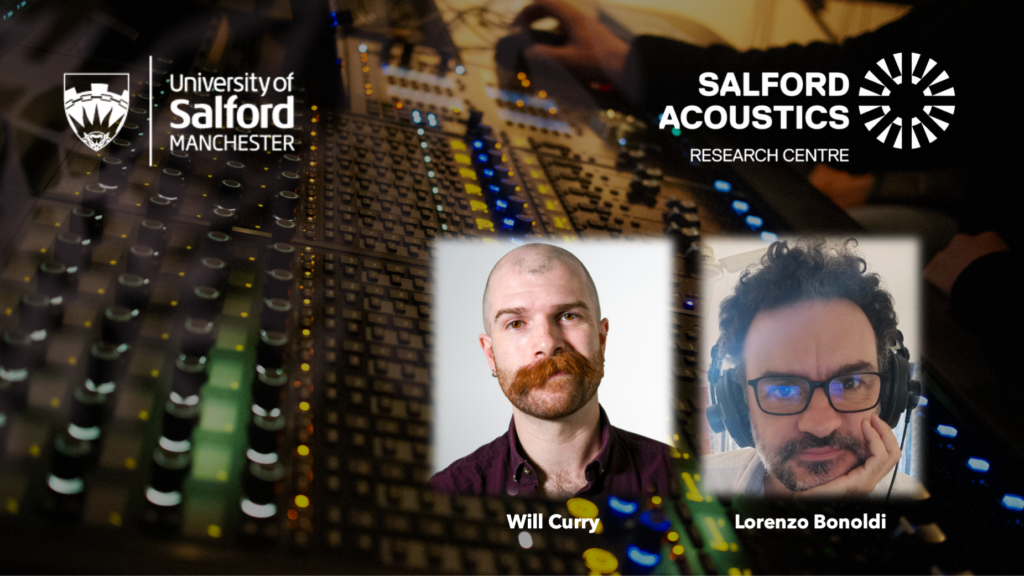
This is the second of the Audio Engineering Society UK Research Student Talks, hosted by the University of Salford. Presenters are:
Will Curry – Beyond Intelligibility: Listening Effort, Comprehension and Enhancement of Broadcast Dialogue
Despite high levels of speech intelligibility, audiences continue to report difficulties understanding broadcast dialogue. This presentation explores the effects of background audio on listening effort and comprehension presenting findings of two studies combining behavioural, subjective and electrophysiological measures for a more holistic assessment of dialogue accessibility. It also examines novel dialogue enhancement techniques designed to reduce listening effort and improve comprehension, highlighting implications for broadcast accessibility, audio quality assessment and production practices.
Lorenzo Bonoldi – Hearing-Diverse Engineers’ Mixes, Heard by Listeners: A Slider Test of Preferred Tonal Balance
Audio engineers usually mix music tracks for an assumed aurally typical music listener, yet hearing varies widely, among engineers as well as among the people who listen to their work. Little is known about how an engineer’s hearing loss shapes the way they mix, or whether mixes made by hearing-diverse engineers suit hearing-diverse listeners. This research addresses both questions.
In Year 1, a questionnaire and interviews with hearing-diverse engineers described their practice. In Year 2, four hearing-diverse engineers, with audiograms measured, each made a standard mix and a remix for their own hearing of one multitrack song. Analysis of the mixes found recurring tendencies: less low-mid energy, equal or lower loudness, preserved dynamics and, in several cases, a narrower stereo image. Descriptive words such as “clear” and “dense” were linked to measurable audio features in a descriptor–metric mapping framework.
The Year 3 test checks whether these tendencies suit listeners with mild to moderate hearing loss generally. Three songs, each as original and remix, are aligned, measured in third-octave bands and cut into short sections. Each section has a slider that moves the tone from the original towards the remix and beyond, at equal loudness. Listeners’ chosen positions will be related to their audiometric thresholds. A MATLAB app runs the test on calibrated headphones.
The test aims to show whether listeners with hearing loss choose tonal balances closer to the hearing-diverse engineers’ remixes, and so whether hearing diversity should guide how music is mixed.
